First, tell us a little bit about yourself. How did you get into print making and for how long have you been doing it?
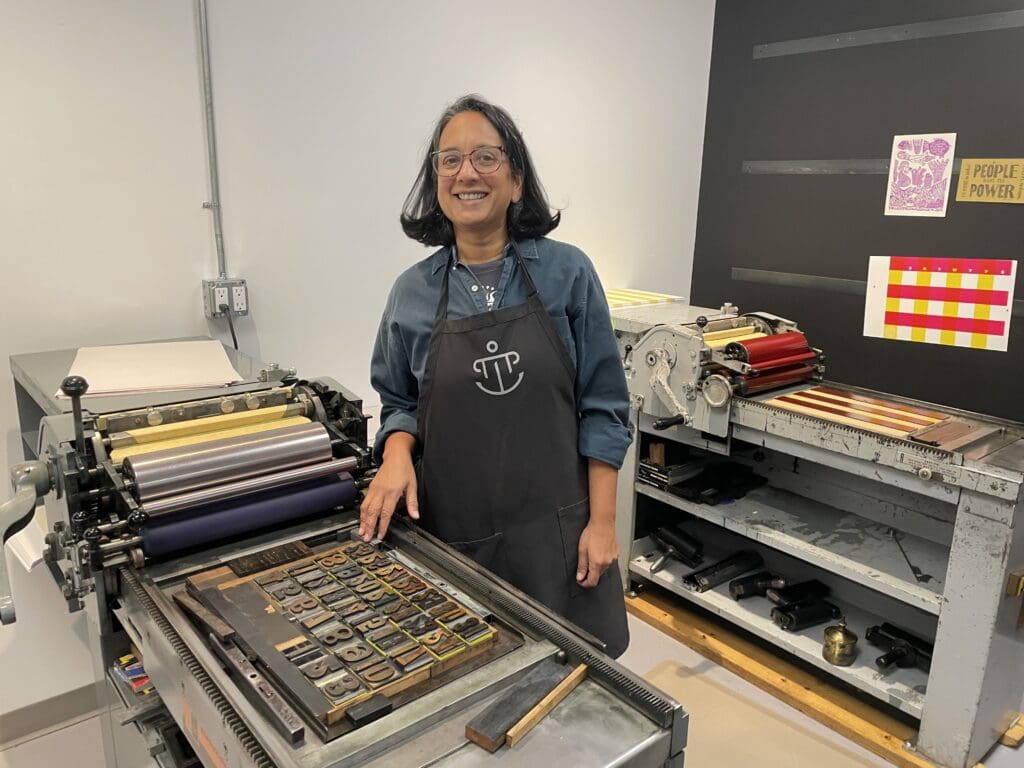
I started taking letterpress printing classes in 2017. I asked my husband for a class as a gift because I liked how letterpress cards looked and felt. There is a warmth and texture to paper that’s been pressed. I didn’t realize it was such a good fit for my interests until I started printing. I have always enjoyed working with paper, and had done a fair amount of collage and incorporated some very basic bookbinding in my classroom as a French teacher. My background was in liberal arts with a masters in Education and my only formal art class was in photography in college. I am still not very confident in my drawing skills, so using type–fonts, letters, and words–as design elements was exciting. My sense of color and composition is intuitive, and I often find inspiration at the museum, in song lyrics, and books. My family will often hear me say “that’s letterpress-able!” when I hear a fun or inspiring turn of phrase.
What do you like the most about teaching print making?
Printmaking is so accessible. The first theme I introduce to students is that almost anything can be printed, it’s just a matter of figuring out how. It can be as simple or complicated as you want. You do not need to consider yourself an “artist” to feel successful. It’s also a great medium for self-expression as it often includes images and text.
My favorite moment in a printmaking class is when someone “pulls” their first print. There is nothing like the look of wonder and delight when a student lifts their paper off of the form and sees a complete impression that they designed. I’ve seen it over and over again with something as simple as a fingerprint or as complex as a paragraph of tiny text.
What are some of your own creative practices or current projects?
I recently completed a calendar for Partners in Print (PiP), a letterpress nonprofit in Belltown, at our print shop. It was the biggest project–12 large pages, 110 copies, 3 colors per page–I had done. A number of people helped with the printing, but I was ultimately responsible for assuring quality and getting it done on time. It was a bit of a stretch, but I learned a lot.
My press at home is small and I use it to make cards. It’s a rare treat these days to receive something in the mail and it’s fun to send handmade cards to loved ones. Birthdays, New Year’s, and transitions are good excuses to make time to get in the shop and make something.
How did you first hear about Arts Corps?
I learned about Arts Corps when I was teaching a workshop at PiP. Jéhan Òsanyìn approached PiP as a possible partner and I taught the workshop they took as part of the process of learning about the organization. We immediately hit it off and started talking about how to incorporate simple presses (Provisional Presses) into the offerings at Arts Corps. Soon after that experience, they invited me to apply to be a Teaching Artist, and I jumped.
As someone who has always enjoyed making things, even if I never considered myself an “artist”, I was drawn to the mission of providing all students high quality arts education. I knew as an educator that the arts are often among the first programs cut in schools. I had also seen how the arts can serve as a means of expression, especially in contexts where not everyone is invited to express themselves.
Can you share with us a little bit of what have you been teaching in your Arts Corps classes?
I am relatively new to Arts Corps and have been teaching printmaking in two elementary schools so far. The big themes I strive to teach are that you can print almost anything; once you make a form, it’s easy to print multiples; everything is backwards; you can build up or carve out to get an impression; and print is a form of expression. I like to introduce materials systematically, so by the time we get to a press, brayers and ink, we’re all on the same page about how to use the tools.
Inspired by Ed Emberley’s fingerprinting book, students have turned their fingerprints into people, animals, vehicles or whatever they like. Recently, some first graders took advantage of the ease of making multiples to make comic strips where the characters were based on their fingerprints. We’ve also used cardboard and foam to make stamps. We will soon be printing corks, potatoes, styrofoam plates and eventually some wood type.